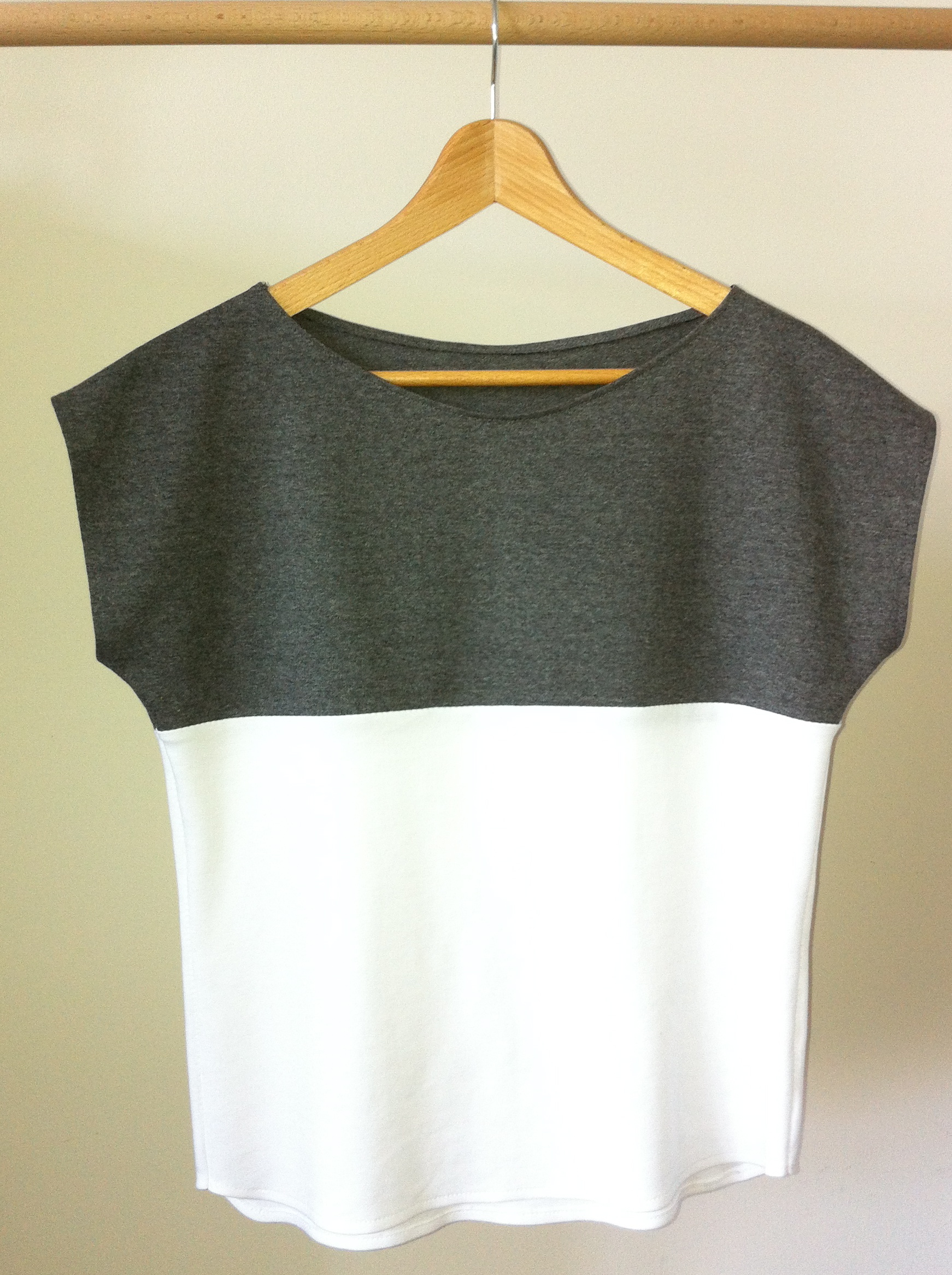
Kirsten Kimono Tee from MariaDenmark
This was a great project: straight-forward pattern (and a free one: the Kirsten Kimono Tee, get yours at MariaDenmark, too!), easy construction, and a flattering, comfortable top at the end of it.
… So of course I had to make things a little more complicated. (Instant gratification and sewing don’t seem to mix, at least not for me. It usually goes something like this: ‘Mmm … that’s nice … or it would be if I drafted a collar for it! It’s only 11 p.m., what could possibly go wrong?!?)
The colour block design was happenstancic (it’s a word. As of now). I had some white jersey left over, but not very much; ditto some grey marl interlock. I measured from my shoulder to just below the widest point of the bust to mark the horizontal break between the two fabrics. I think it balances the top and bottom nicely, almost creating the illusion of an empire waist – helped also by the fact that the white is a little more drape-y than the grey, making it fall just so.
I added a shirt-like hem (curving downwards from the side seam), longer at the back, which I reinforced with very light fusible cut on the bias. This was admittedly a bit fiddly. First to get the strips fused on the curl-prone jersey, and then to fold the hem into the right curves – I made a little pleat in each corner to control the excess of fabric, but without making it pointy. I found it really helpful to pin the hem to the ironing board, press, and then stitch.

How to de-fiddlize a tricky hem
Fusible as a stabiliser seemed to be just the thing (in fact, Maria from MariaDenmark did a really good tutorial on that recently), so I used some more for neckline and sleeve hems. This makes for nice, smooth seams when sewing on a conventional machine. However, there is no stretch in these seams. None whatever – the strips were on the bias in order to mould well to the curves, but the straight stitch negates any flexibility. That’s OK, though, because the seams don’t really need to stretch – I wanted a loose fit – but it wouldn’t work otherwise (next time: twin needle). I should also add that the side seams and the horizontal seam are zig-zagged, so the top taken as a whole is not altogether without stretch.
Both knits have a good weight to them (as mentioned, the grey more than the white). This adds structure to the top, and emphasises the kimono sleeves. I do like like that grey-white combo; the grey becomes almost like brushed steel next to the white. In a good way. To my mind, it’s one of those tops you can use for just about any occasion – it’s got that day-to-night thing going on. I often wear it with dark, slim jeans and a long silver chain (as shown in the picture), flats, heels, trainers … (It washes well, too, which is fortunate considering how much I use it.)
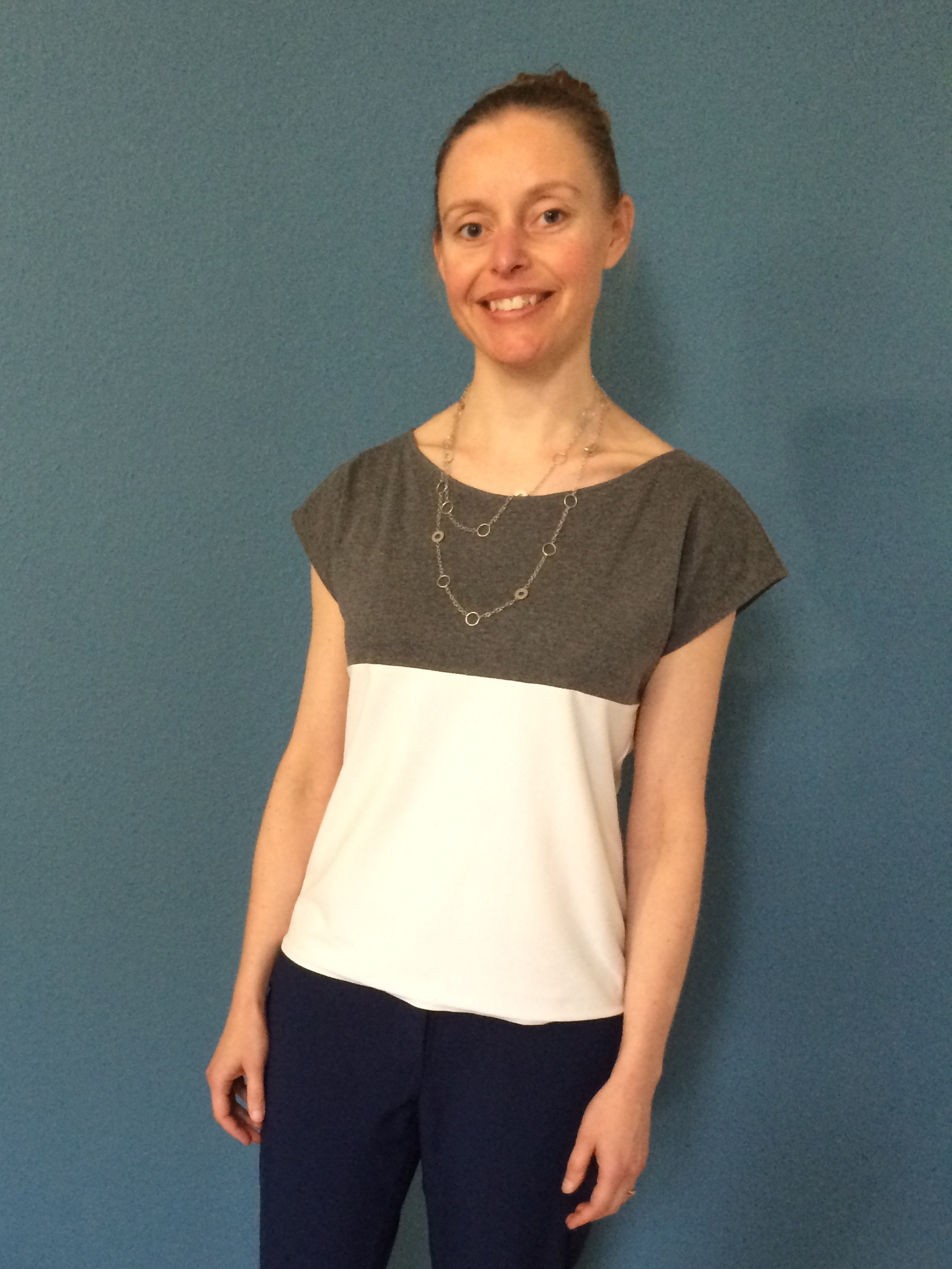
Oh, look, it’s me!
I’ve sewn it twice since, for friends who paid me the ultimate compliment of asking very nicely if I might make one for them, too. What can I say? They make good fashion choices.


 Carefully Sewn