
Two maternity dresses Continue reading
Two maternity dresses Continue reading
Burda Germany is currently hosting a competition, the subject of which is to sew an outfit that you would wear to Berlin Fashion Week. I am participating with a top-trouser combo, which I managed to get done just in time for the deadline (so the photos had to be done on a cloudy day around sunset; the denim trousers are not exactly showing their best side).
It’s just the kind of thing I would wear out here in Berlin: trousers that look smart but are really just a pair of jeans (well it’s denim, anyway), and a top with clean lines and a bit of a sporty edge to it. If you feel so inclined, you can cast your vote here. (And if you should choose to spend your vote on me, thank you very much!)


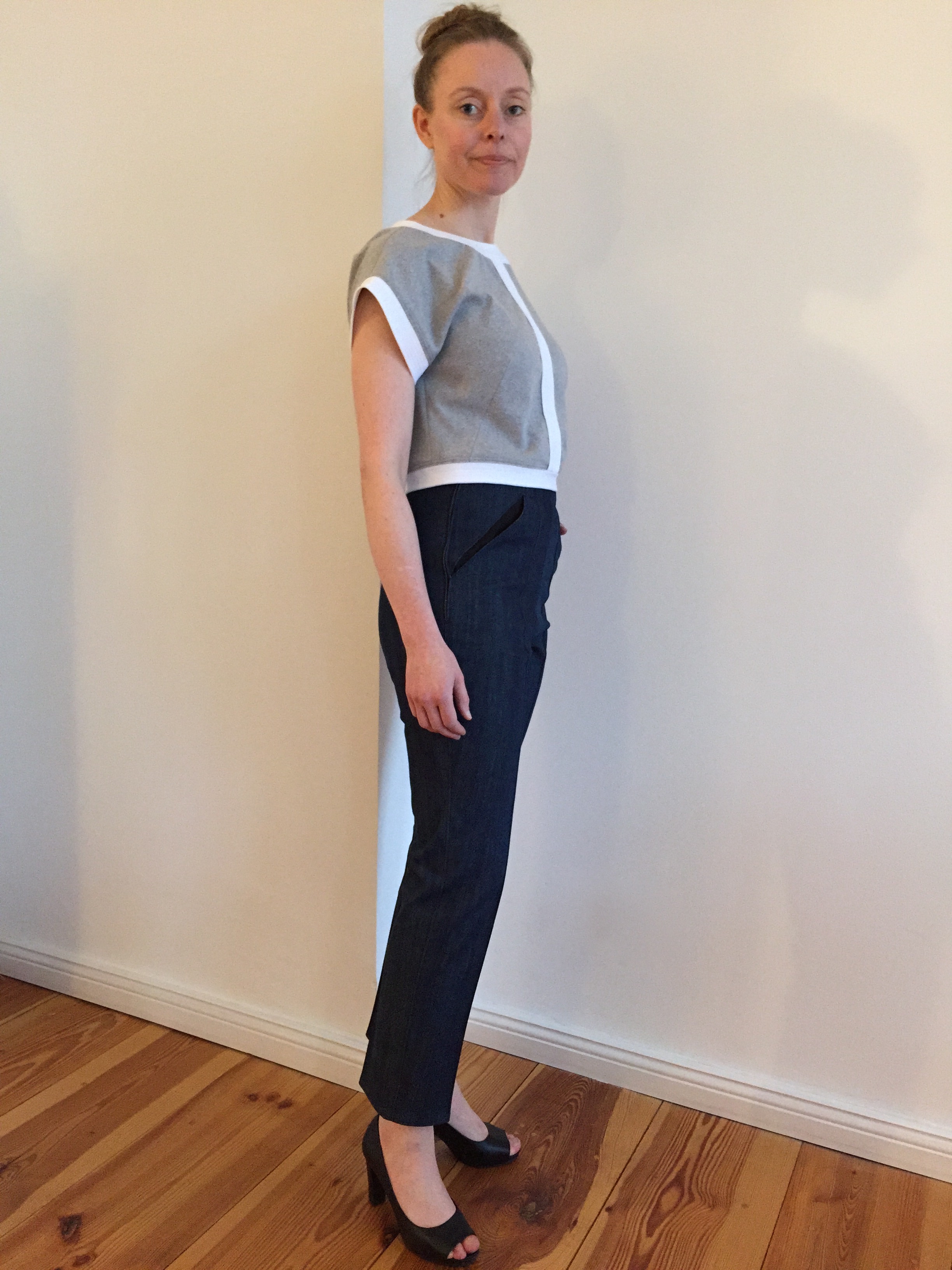
A few details. The top is of grey merle cotton jersey; it’s pretty thick so I guess it’s ponti jersey. The white bands are also knit, but polyester. There are French darts and a sway-back, which means that it doesn’t end up too boxy, nor does it flare out tent-style, which is how many cropped tops would look on me. The bands are channel-stitched, which gives the fabric a bit of stand – this in particular helps to emphasise the kimono-sleeves. And no, those rows of stitches do not stand up to close scrutiny. Thank god I didn’t go with my first plan, which was to do them in grey thread for a bit of impact.
The trousers sits on the natural waist, with the hem on the ankle. The front and back crease line is emphasised with top stitching done with a twin needle. Fun fact: thick top stitching thread and twin needles do not mix. The thread burst all the time – it sort of twisted round the way it does when you sew by hand, and got stuck in the needle eye. At least that’s what I think happened. I’m pleased I persevered, though: it means there’s a nice crease even on days when you can’t be bothered with pressing. I bought the fabric in Copenhagen a while back, some vintage denim (whatever that means) on sale and with an extra discount on top because I got a bit excited and bought more than I strictly speaking needed (although ‘need’ is a somewhat irrelevant term when it comes to buying fabric, don’t you find?). These trousers were cheap is what I’m saying; they also happen to be the best fitting trousers I have ever owned.
So, who knows whether I win or not – it would be nice, admittedly – but either way I have a pretty cool made-by-me outfit. (But seriously, don’t look at the channel stitching.)
This was actually the first shirt I made from the Burda 7045. The owner-to-be was my dad, whose body shape meant that the pattern needed a few adjustments. Usually, he buys plus sized shirts that fit him around the waist, but are then too long, and too wide over the shoulders. The resulting look is less than flattering, adding volume where it is not needed. In other words, it was not an option simply to grade up the pattern.
The length, shoulder and neck was just fine in a size 60, but space was needed for the stomach. To do that I slashed the pattern from mid shoulder to the hem, and spread until the waist measure was right. Then I re-drew the arm scye and the side seam. (Oh, how quick it is to write it! I had never done anything of the kind before, so it took me ages to work out how to go about it, and then actually do it.) I didn’t have the option of making a muslin to check fit (we live far apart), so I did fret over how it would turn out.

Is that right? Is that how it’s supposed to be?

Nothing beats a crisp collar. Nothing.

Hopefully it will take the attention away from the slightly misaligned pocket. Sigh. Checks are not very forgiving in that respect.

Bias tape to finish sleeve hem.
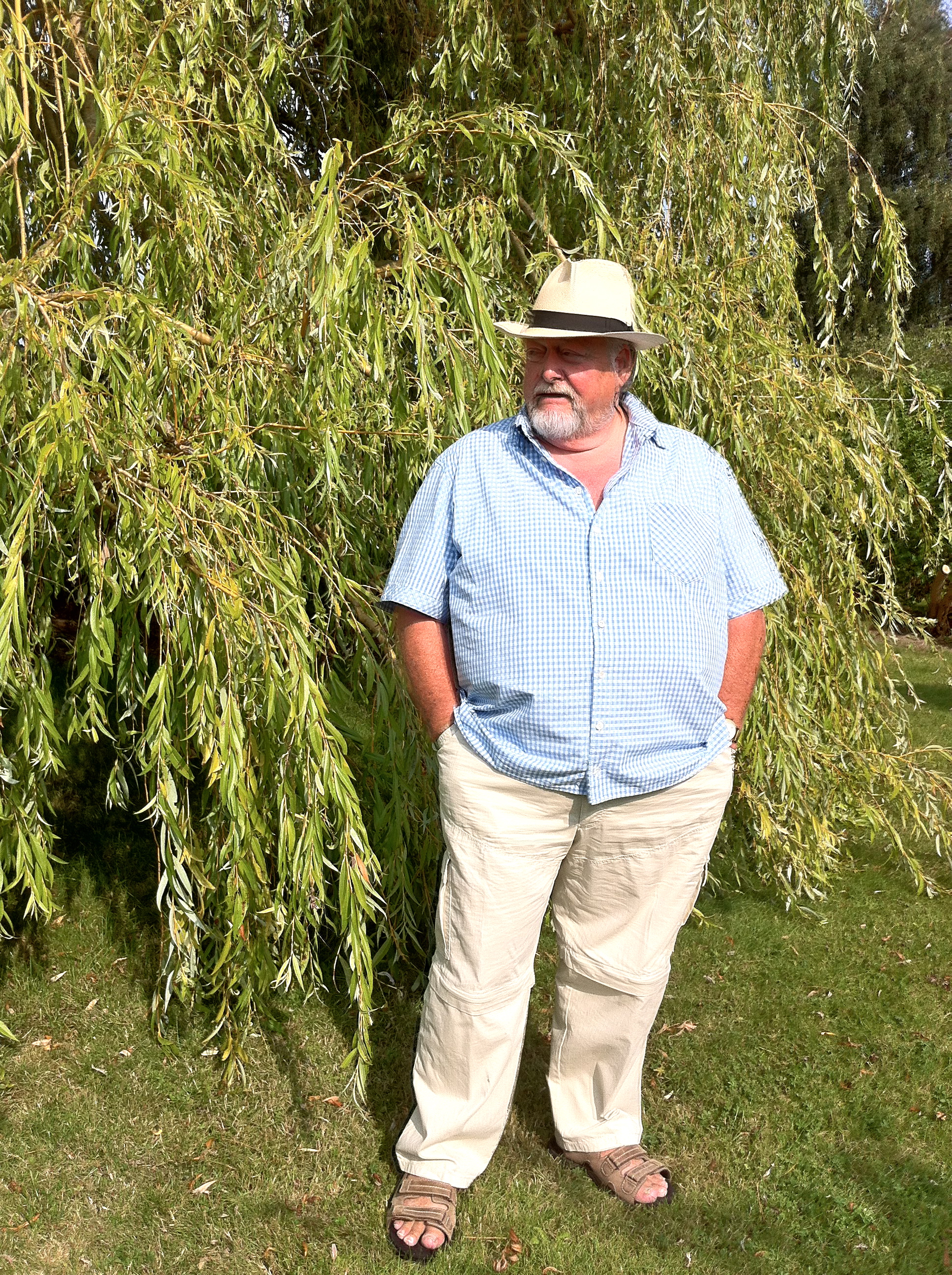
It was alright on the day, though. Not only that, my dad was just so pleased; he even made favourable comparisons to clothes that his dad – a tailor – had long ago sewn for him. That felt rather good, have to say.
Here he is, looking dandy.
‘Hey.’
Very good of the sun to play along. One of many times this late summer – and now autumn – when you couldn’t have a conversation without someone eventually saying, ‘better enjoy it, could be the last good day of the year.’ We did.
It is not unusual for a kind of barter economy to spring up among friends: you help with a move and are fed in return, or pay your pet feeder or plant waterer with gifts from the holiday you went on. However, some friends bring more to the table than a bit of practical sense and goodwill. Rather than spend the best of the day speculating on the role of washers or what it means that something is ‘earthed’, they have real, professional knowledge of tasks that could otherwise go horribly wrong. (Plumbers and electricians must have the most faithful friends in the world). And then it just doesn’t seem right simply to spring out for a few bottles of red wine.
Take my good friend Gabriele, a trained hairdresser and colouring specialist with the papers and experience to prove it. She is somewhat overqualified to snip the ends of my hair. But she does it anyway (in addition to the above, she is also nice), and so I thought it would only be fair if I made her a dress in return.
First we looked at pictures to narrow in what she was after, spoke about fabric and what occasions she wanted the dress for. Based on that I made a few sketches.
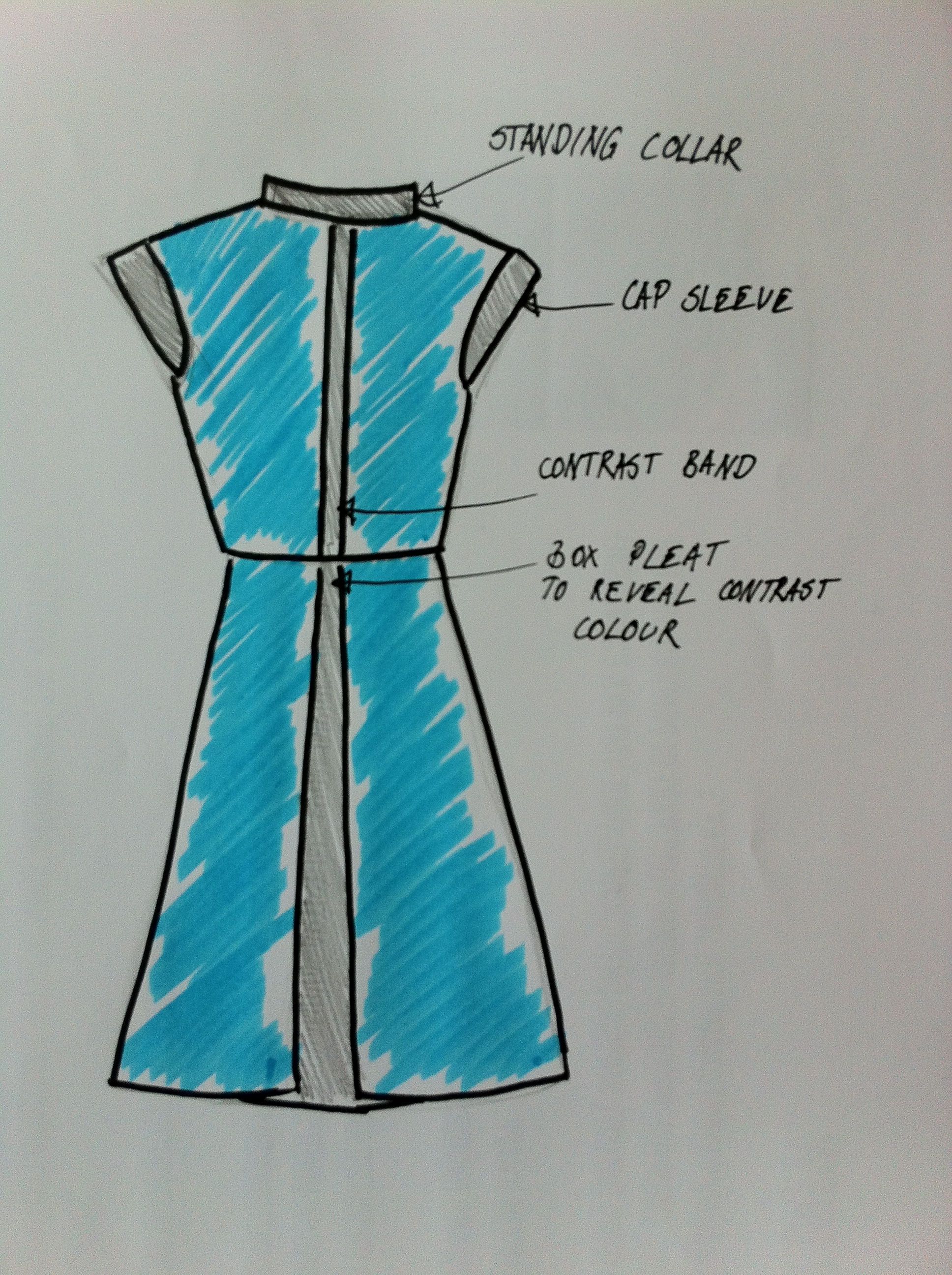
Dress sketch I – the winner!

Dress sketch II – also nice, just less so.
Then we went to look at fabric. She wanted a summery dress that would work both for day and evening – smart casual, in other words. Without any encouragement from her denim fanatical dressmaker, she chose an indigo cotton twill, and a chambray/denim-like plain weave with a textured grain. It was just such a pleasure to work with, and look at.
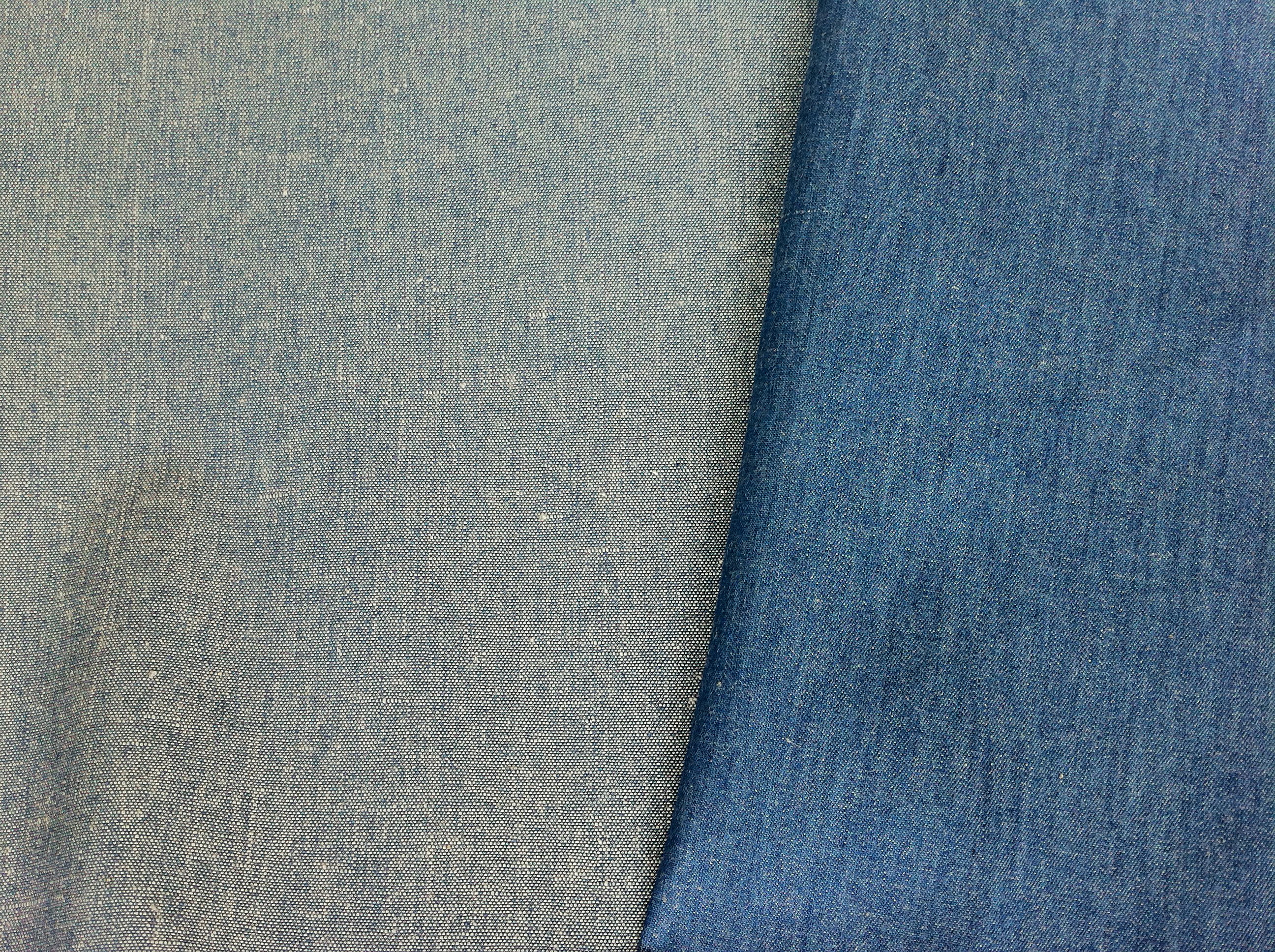
Two times denim. Mmmm …. denim …
The bodice is Gretchen Hirsch’s cap sleeve cocktail dress, from Stitch with Style 2013. I redrafted the neckline to fit the standing collar, and drew the skirt myself. I didn’t line it – the fabric had plenty of stand, and Gabriele would not be needing it for warmth. However, the fabric did like to fray so all seams were either felled on the inside, bound with bias tape, or hand overcast.

Not a loose thread in sight.
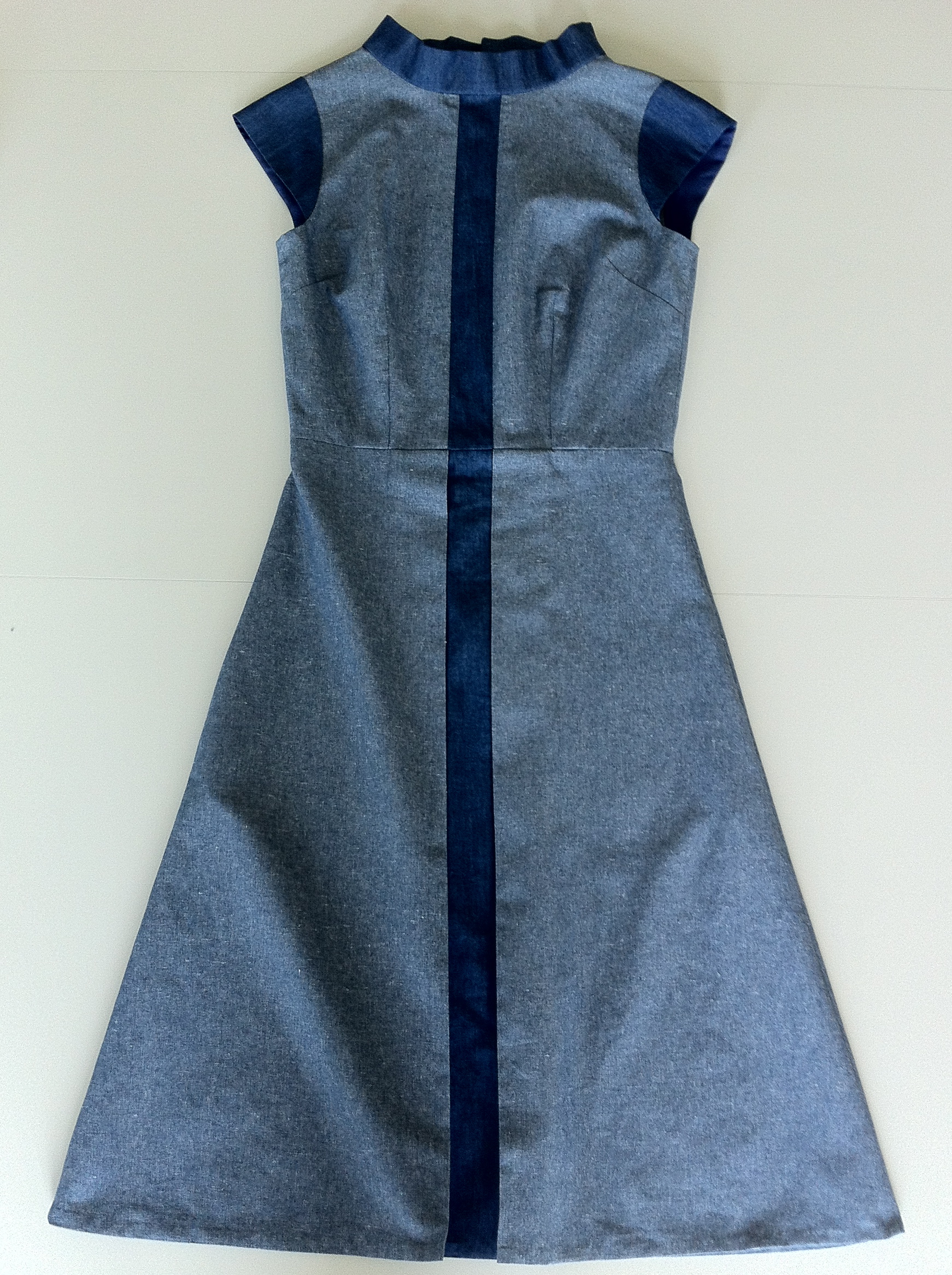
The finished dress …

… and its new owner. Looking good!
She was very pleased. So was I – I’ll have a clear conscience when I go for a trim next.
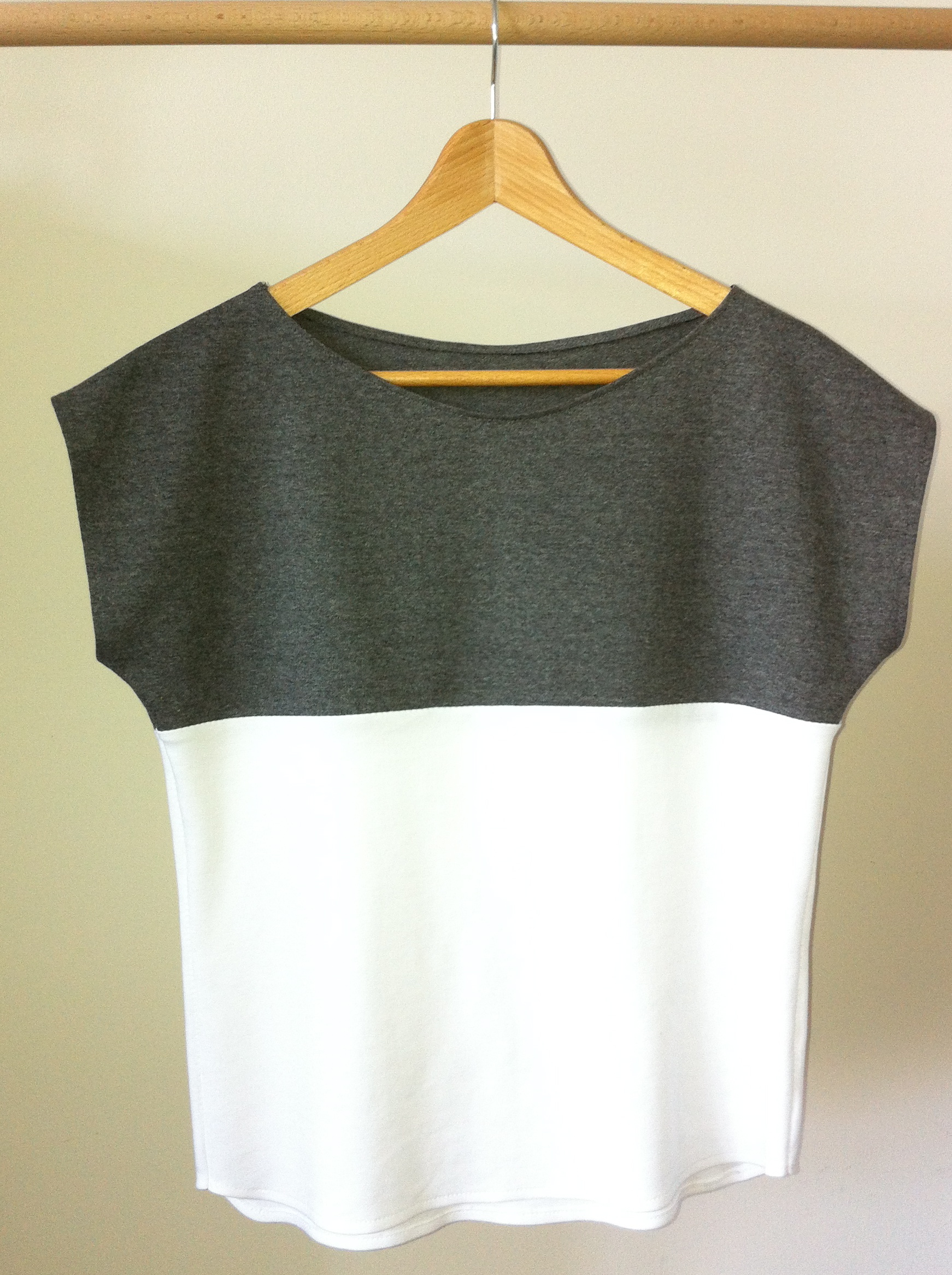
Kirsten Kimono Tee from MariaDenmark
This was a great project: straight-forward pattern (and a free one: the Kirsten Kimono Tee, get yours at MariaDenmark, too!), easy construction, and a flattering, comfortable top at the end of it.
… So of course I had to make things a little more complicated. (Instant gratification and sewing don’t seem to mix, at least not for me. It usually goes something like this: ‘Mmm … that’s nice … or it would be if I drafted a collar for it! It’s only 11 p.m., what could possibly go wrong?!?)
The colour block design was happenstancic (it’s a word. As of now). I had some white jersey left over, but not very much; ditto some grey marl interlock. I measured from my shoulder to just below the widest point of the bust to mark the horizontal break between the two fabrics. I think it balances the top and bottom nicely, almost creating the illusion of an empire waist – helped also by the fact that the white is a little more drape-y than the grey, making it fall just so.
I added a shirt-like hem (curving downwards from the side seam), longer at the back, which I reinforced with very light fusible cut on the bias. This was admittedly a bit fiddly. First to get the strips fused on the curl-prone jersey, and then to fold the hem into the right curves – I made a little pleat in each corner to control the excess of fabric, but without making it pointy. I found it really helpful to pin the hem to the ironing board, press, and then stitch.

How to de-fiddlize a tricky hem
Fusible as a stabiliser seemed to be just the thing (in fact, Maria from MariaDenmark did a really good tutorial on that recently), so I used some more for neckline and sleeve hems. This makes for nice, smooth seams when sewing on a conventional machine. However, there is no stretch in these seams. None whatever – the strips were on the bias in order to mould well to the curves, but the straight stitch negates any flexibility. That’s OK, though, because the seams don’t really need to stretch – I wanted a loose fit – but it wouldn’t work otherwise (next time: twin needle). I should also add that the side seams and the horizontal seam are zig-zagged, so the top taken as a whole is not altogether without stretch.
Both knits have a good weight to them (as mentioned, the grey more than the white). This adds structure to the top, and emphasises the kimono sleeves. I do like like that grey-white combo; the grey becomes almost like brushed steel next to the white. In a good way. To my mind, it’s one of those tops you can use for just about any occasion – it’s got that day-to-night thing going on. I often wear it with dark, slim jeans and a long silver chain (as shown in the picture), flats, heels, trainers … (It washes well, too, which is fortunate considering how much I use it.)
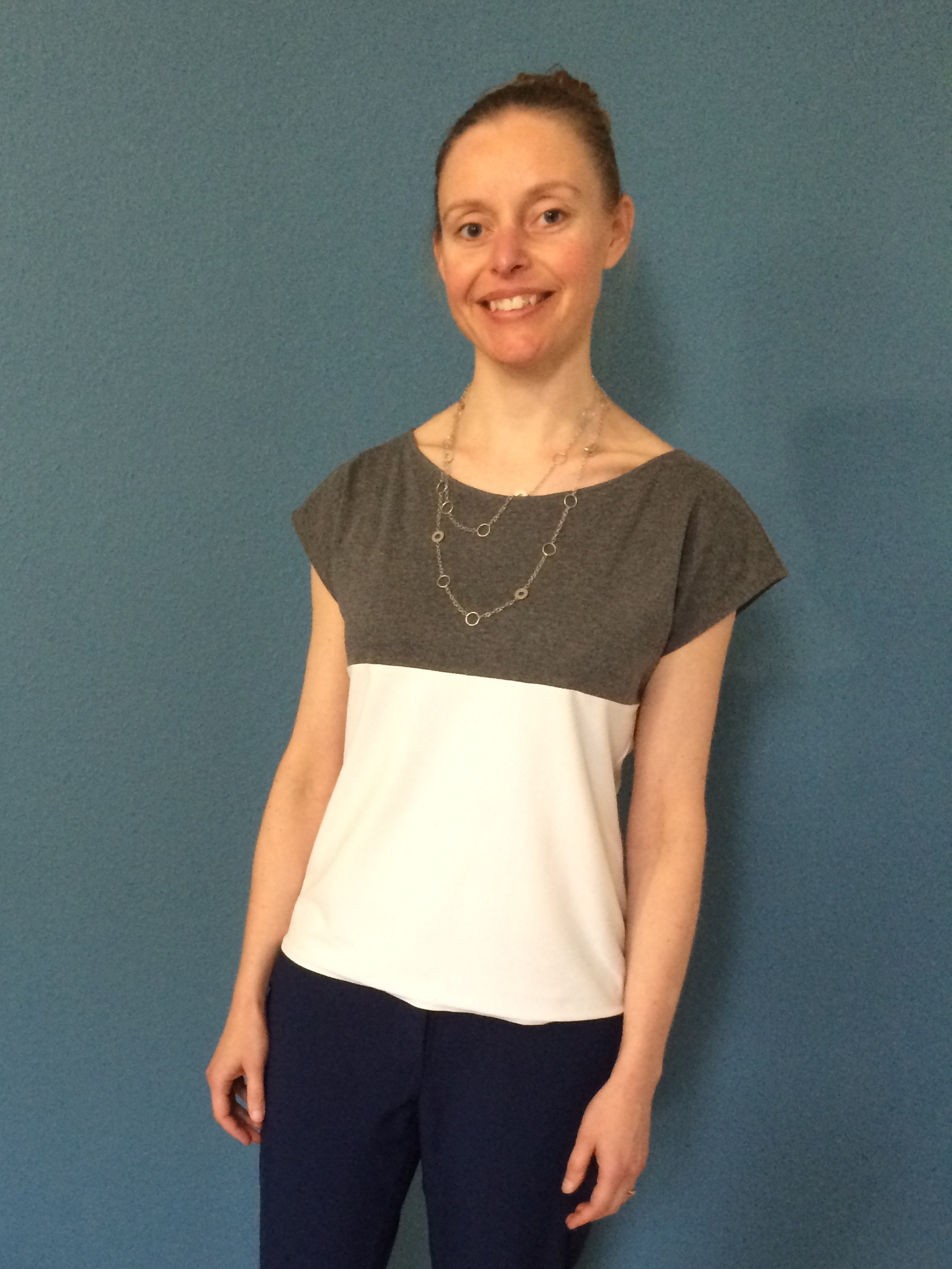
Oh, look, it’s me!
I’ve sewn it twice since, for friends who paid me the ultimate compliment of asking very nicely if I might make one for them, too. What can I say? They make good fashion choices.
The promise was made back in May, but only fulfilled last week: a summer shirt. The pattern is Burda 7045, a straight-forward man’s shirt, with three variations that combine various collars, pleats and pockets.

Shirt looks nice, too.

Pretty happy with that fit, saying so myself n’all.
I chose a standard collar (‘A’), a pocket, and pleats back and front. I added a bit of variation of my own, too. The sleeves are short, but instead of a simple folded under hem I used the cuff. It gives it a bit more ‘finished’ look, I think, more smart than casual, you might say.
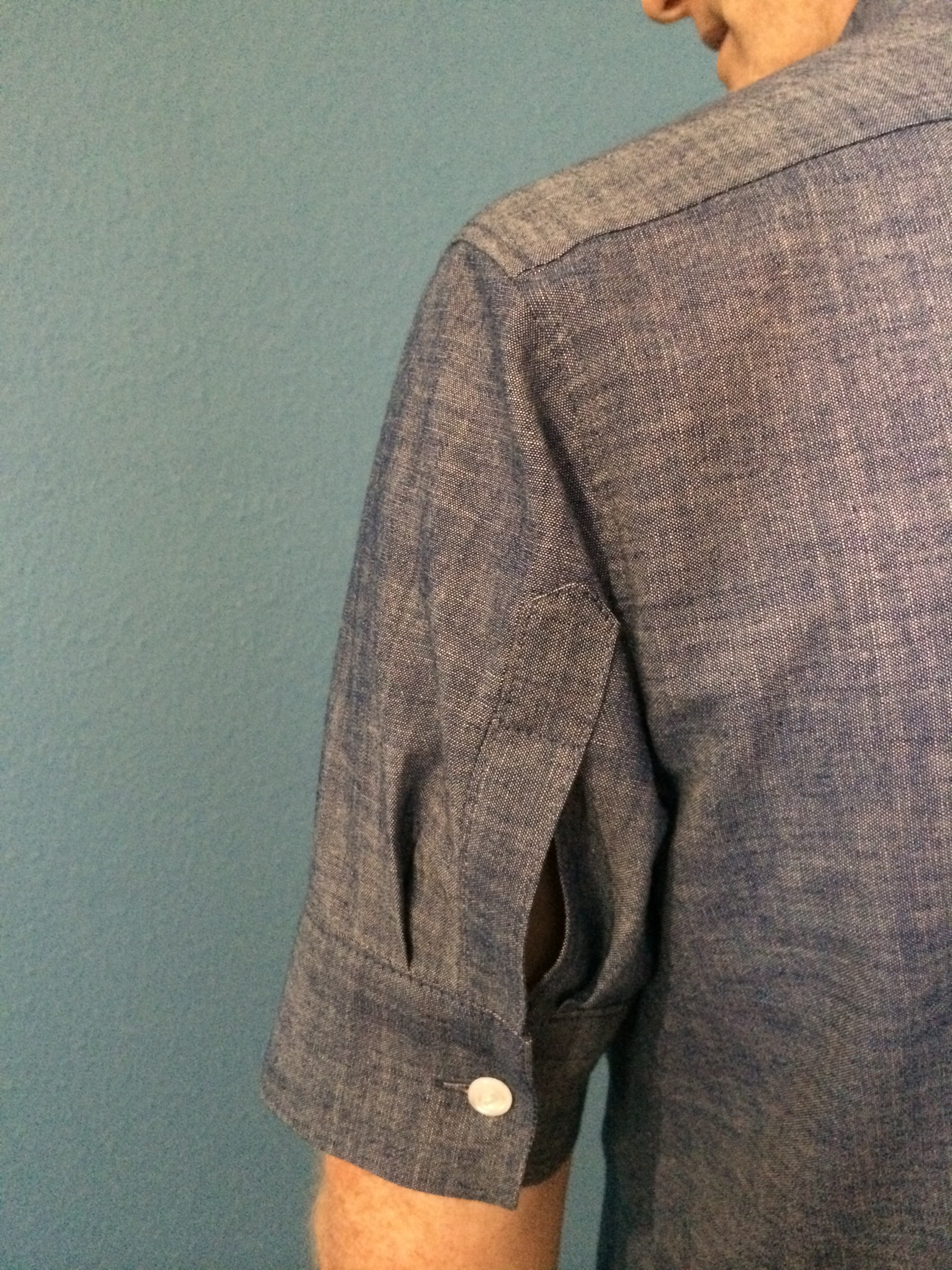
Cuff detail
I took his measurements (chest, waist, shoulders), and compared with the corresponding measurements taken from the pattern (a situation when it’s actually an advantage not to have seam allowances included in the pattern). Not a single adjustment needed: as if by magic, my husband fits a size 48 perfectly.
The fabric is a organic cotton denim, with a straight weave. When freshly pressed it’s wonderfully crisp, which seems to highlight the crisscross pattern created by the weave; with wear it softens and the various tones of blue come to the fore. This fabric is just so nice. (You can get the fabric from Siebenblau, Berlin, a shop selling only organic fabric.)
This is the second time I have used this pattern. I haven’t encountered any problems, at least not relating to the pattern itself (rushing, and not double checking stuff; can’t blame Burda for that). I would say that if you have not made a shirt before, do expect to read the instructions a couple of times – preferably once before you begin. The sleeve slit and placket in particular can be a bit tricky, both to do and to understand how to do. And when the instructions say baste, baste. I found it much easier to get the fabric to behave properly that way.
Very happy with how it came out, and so is my husband. Win-win.

Would look great with a baguette and some curly lettuce sticking out.
One of my first sewing projects: the denim shopper bag, made from a pair of old jeans, deemed by my husband to be past their fashion sell-by date. The fabric was in good condition, though, and as the trousers were from a time when cargo-pants were still in recent memory, there was also a lot of it. I used it down to the last scrap, more or less.
It took ages to make, a combination of my inexperience, and inexplicable pleasure in unpicking seams (rather than just cut the seams away and be done with it). The bag is a success, though: shopping, picnics (once, anyway), those days when you need to carry water, an umbrella, sunglasses and a jacket; it takes bottles to the bottle bank, and it will even fit one of those frozen pizzas that I’m not sure if I disguise because frozen pizzas are an abomination, or because I buy the organic ones.
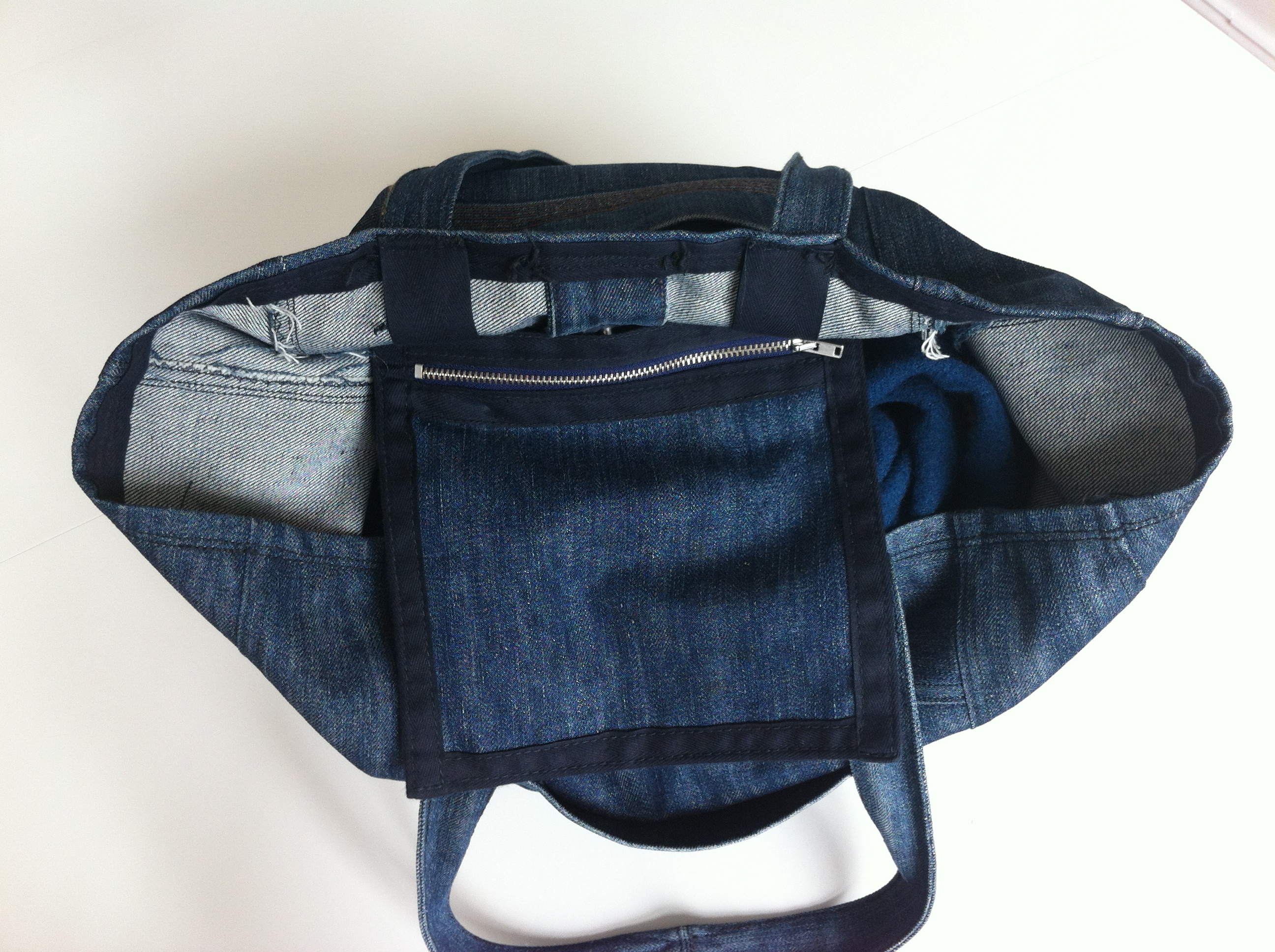
Inside pocket
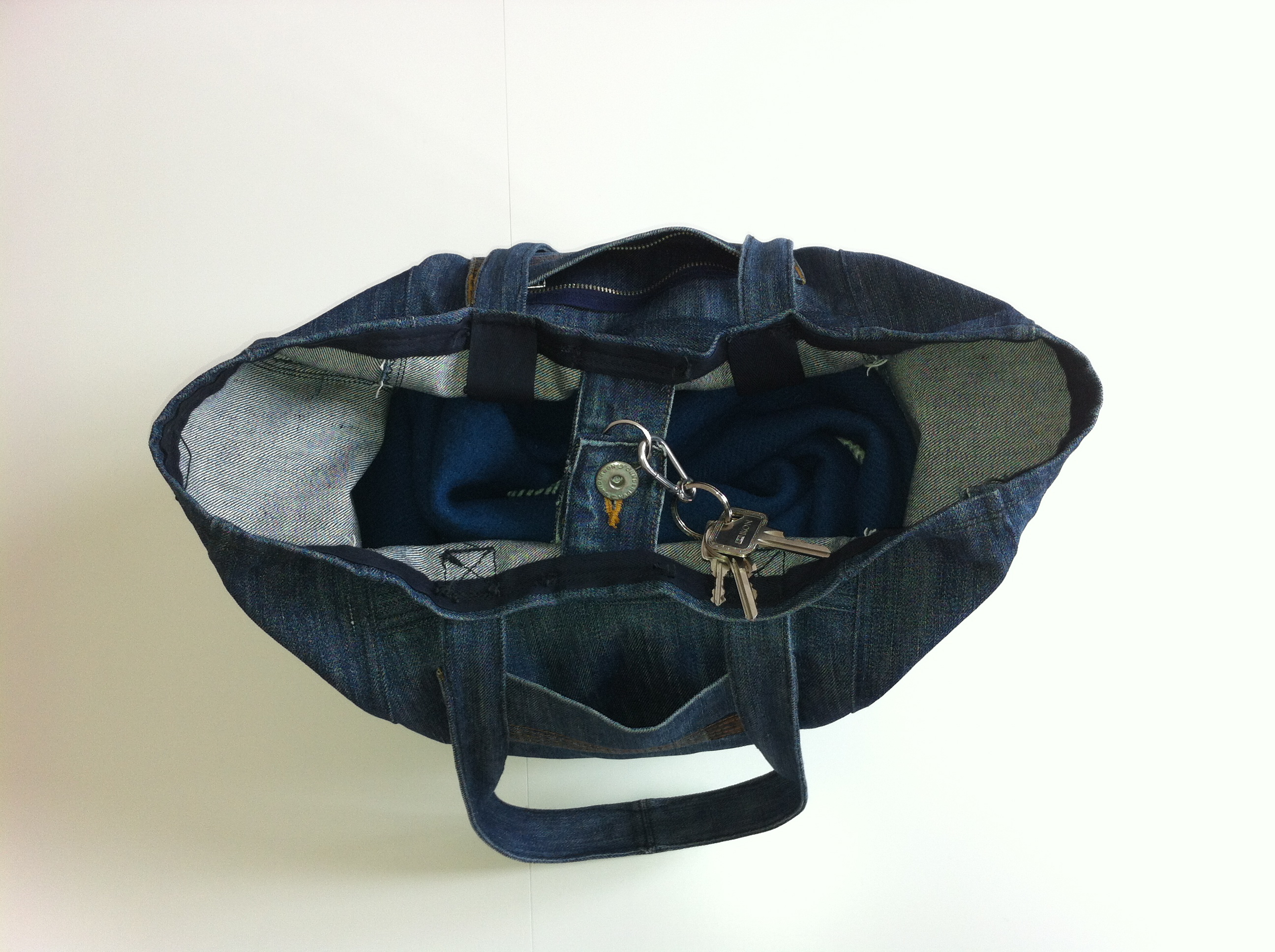
Zipper in outside pocket, the waistband closure, and the key holder. Ready for black tie event.
It has eminently practical details. One of the outside pockets (the original back pocket) has an internal zipper, and there’s an inside pocket with a zipper, too, meaning that I don’t have to worry about phone or wallet falling out. The ends of the waist band have become a way to close it, and there’s a ring to hook my keys onto – though that detail is actually not so great, as it means the keys make this annoying dangly-chiming noise.
It’s one of those bags you like so much that you become convince it’s way more versatile than it really is.
 Carefully Sewn